Aug 13
Outside Bay Area, LGBTQ centers facing new reality
John Ferrannini READ TIME: 4 MIN.
Outside the Bay Area, the Sacramento and Los Angeles LGBT centers are addressing budget cuts similar to their counterparts. In Northern California, the Sacramento center is dealing with uncertainty over a federal grant, while in Los Angeles, there has been a small victory, at least for now.
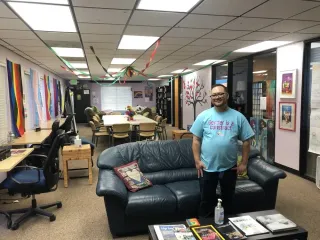
The Sacramento LGBT Community Center is located at 1015 20th Street, in the California capital city’s queer Lavender Heights neighborhood. Executive Director David Heitstuman, a gay man, told the Bay Area Reporter that ongoing federal funding for the center provided through the Substance Abuse and Mental Health Services Administration was pulled earlier than expected this spring and after the center had already provided the services it funded.
“It was going to expire at the end of June,” Heitstuman said in a May 20 interview at the center. “We got a notification on the second of April, I believe, that it had been terminated on March 24. That grant paid for a number of different mental health services, but it fully funded two mental health clinical positions and two peer-support specialists, so four full-time employees.”
Thankfully, that funding was restored after California won a court injunction, Heitstuman stated when asked for an update this month.
“The state of California fought back against the illegal federal cuts and won an injunction, which temporarily restored SAMHSA funding for our mental health programs through the end of August, but we remain deeply concerned about what lies ahead,” Heitstuman stated August 7. “Additional federal cuts, political intimidation, and coercion by the Trump administration on institutions, and the trickle-down impacts on state and local government, are also harming our community.”
When the cuts were first learned of earlier this year, the center successfully worked to “ensure people who already had appointments or were engaged in services didn’t have those abruptly terminated,” Heitstuman said.
But while the center was able to find spaces for people, they were of a temporary nature, he said.
“We won’t be able to sustain that long term,” said Heitstuman.
The cuts also led the center to scrap a summit and conference meant for mental health providers, Heitstuman said. The loss was some $500,000 in federal funds; the latest IRS Form 990 for the center – for the year ending in December 2023 – shows it brought in $6.2 million and spent $5 million.
The same day as the B.A.R. visited the center, it lobbied the Sacramento City Council to provide $417,000 in funds from the Sacramento Children’s Fund to replace what had been axed from the feds. According to the center, it serves 400 youth ages 14-24, 42% of whom are unhoused or at risk of homelessness.
“We need to support the Sacramento LGBT Community Center mental health programs (through the Sacramento Children’s Fund), I know a lot of queer youth who would benefit from the Center’s time and support,” stated Navaeh Trigo, a queer member of the center’s youth advisory board. “We need our youth to know that they are more than just a number or statistic, they’re real, their experiences are real and they matter.”
On June 8, the Sacramento City Council did allocate $17.9 million to Sacramento Children’s Fund grantees. The center received $400,000 of that.
“We are grateful that the Sacramento City Council recently approved the first Children’s Fund allocations, which will help partially fund affirming mental health services for LGBTQ+ youth and build capacity through training new therapists,” Heitstuman stated.
The Sacramento center provides HIV testing and other sexual health services, free counseling for crime victims, a transitional living program, and short-term transitional emergency placement programs for up to 24 months for 18-to-24-year-olds who’ve been victims of crimes. (The transitional living program houses 18-to-24-year-olds for an average of 90 days.) It also runs the Q-Spot youth program, open Monday-Friday, noon to 6 p.m., and Saturday, 10 a.m. to 4 p.m.
Heitstuman said that the SAMHSA funds are the only federal monies that’ve been terminated. But that could change, he warned, as the center has about $1.2 million in other federally-funded activities, such as the center’s housing programs.
“The ongoing uncertainty around federal support puts entire care infrastructures at risk – not just for our organization, but for communities across the country who rely on these essential programs,” Heitstuman stated August 7.
The center also puts on Sacramento’s annual Pride festival and parade, held the second weekend of June. The San Francisco LGBT Pride Celebration Committee made headlines earlier this year when it announced some corporate sponsors withdrew after President Donald Trump was sworn in to his second term in January. LGBTQ community centers in the Bay Area told the B.A.R. they too saw trepidation.
A similar drop off occurred in Sacramento, with Heitstuman noting corporate sponsorships for the city’s Pride festival were down roughly 30% this year from past years. And Greater Palm Springs Pride announced August 8 that it was facing a reduction of $325,000 in corporate sponsorships but that the November 6-9 event will go on as planned.
“I am concerned that the trend is continuing, whether it’s economic uncertainty or people’s personal economic problems, or, you know, just nervousness and fear generally? I’m not sure,” said Heitstuman. “Pride’s an incredibly expensive enterprise. To produce it costs double what it did before the pandemic. I’ve heard a lot of event providers say that since the pandemic things have doubled or even tripled.”
Indeed, as the B.A.R. reported , the San Francisco AIDS Foundation and the Los Angeles LGBT Center held their final AIDS/LifeCycle ride in June, citing increased event production costs since the pandemic. SFAF will launch a new three-day fundraising ride through the North Bay May 29 ending with a two-night stay in Guerneville, registration for which is set to open this fall.
LA center gets funding back, for now
SFAF and the Los Angeles LGBT Center, after having had funding cut by the Trump administration, were two of several nonprofits that took the president to court, which as the B.A.R. reported last month, led to their funding being restored, at least for now, after a judge granted a preliminary injunction blocking the funding cuts while the case proceeds.
U.S. District Judge Jon S. Tigar ruled the Trump administration can’t use executive orders the president signed earlier this year to defund nine LGBTQ and HIV-related organizations.
Specifically, the suit – San Francisco AIDS Foundation v. Trump – challenges executive order No. 14168, which states that, “It is the policy of the United States to recognize two sexes, male and female,” and defines sex as “an individual's immutable biological classification” and not a synonym for gender identity. This order on gender identity also prohibits federal contractors and grantees from recognizing and respecting their identities or advocating for their civil rights. The lawsuit also challenges executive orders Nos. 14151 and 14173, which terminate equity-related grants and prohibit federal contractors and grantees from employing diversity, equity, inclusion, and accessibility principles in their work.
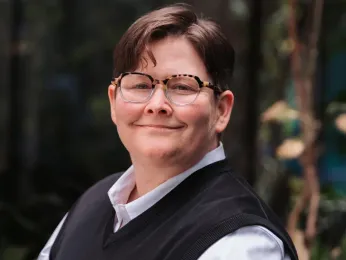
Joe Hollendoner, a gay man who used to be CEO of SFAF, is now the LA center’s CEO. For this article, the center made available Terra Russell-Slavin, a gender-expansive lesbian who is its chief strategy officer. She told the B.A.R. in a June 12 phone interview (before Tigar restored the funds) that, “I would say there was about $6 million in canceled funding but over multiyear periods.”
The center is, “the largest LGBTQ service provider in the country,” she said, and it provides comprehensive social services, HIV testing and treatment, and is one of the largest providers of gender-affirming care in the state of California. It operates out of 10 locations across Los Angeles County, but its administration is headquartered at the Anita May Rosenstein Campus at 1118 North McCadden Place in Los Angeles.
Thankfully, Russell-Slavin said, “We have not had to eliminate services” due to the Trump administration’s attempt to cancel their federal contracts.
“But what we do know is if the money doesn’t come through, it’s going to lead to more wait lists, it’s going to mean people untreated for medical conditions, including STIs, and that we will have long-term impacts that will likely cost the state and federal governments more money than the upfront, preventative work,” she said.
The situation for trans people seeking health care has been affected in Southern California. Children’s Hospital Los Angeles ended care for transgender patients July 22. It’s one of a number of medical facilities across the country that have either stopped trans care or reduced services for trans minors.
Reached for comment August 6, Russell-Slavin said the LA LGBT Center still provides care for trans adults and makes referrals for trans, nonbinary, and gender-expansive youth.
“The Los Angeles LGBT Center continues to provide the same broad range of gender-affirming care services for LGBTQ+ patients ages 18 and older that we offered prior to President Trump taking office,” she stated. “No one – not even the president – can erase the transgender community. While the center does not provide medical care to individuals under 18, we work closely with TGNBI+ youth through many of our other programs to ensure they have affirming access to support, resources, and care.”
After Children’s Hospital LA announced in June that it would stop providing gender affirming care to people under the age of 19 to comply with Trump’s Executive Order 14187, titled “Protecting Children from Chemical and Surgical Mutilation,” the LA center helped facilitate four weeks of protests.
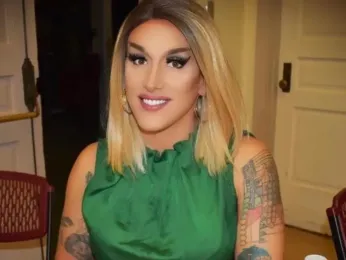
Maebe Pudlo, who identifies as trans and nonbinary and is also known by their drag name, Maebe A. Girl, told the B.A.R. that the demonstrations have expanded to the Los Angeles Kaiser Permanente location across the street after the Oakland-based health care provider announced it would pause gender-affirming surgeries for trans people under 19. That goes into effect August 29.
Pudlo is a candidate for the open state Senate District 26 seat in next June’s primary. They are an elected member of the Silver Lake Neighborhood Council.
“I’ll say I’m a big fan of the Los Angeles LGBT Center,” Pudlo said in a phone interview. “They do a lot for our community. They are open and welcoming in many different ways. They do a lot in terms of helping folks get back on their feet. They have people addressing homelessness, accessing gender-affirming care, and they do a tremendous amount of work for the community.”
The B.A.R. spoke with Russell-Slavin at the height of the immigration enforcement raids that galvanized Los Angeles. She said it was “absolutely awful that the Trump administration” had not only called in the National Guard, but also the Marines, against local civilians.
“Our clients are scared. We have many clients who are immigrants, and regardless of status, they are fearful in this moment because there is a lawlessness to this,” she said. “What used to be fundamental due process rights are being thrown out the window. The feeling that at any moment members of the community can be attacked feels palpable. We are resolutely standing by our immigrant community that is LGBTQ and shoulder-to-shoulder with immigrant groups.”
Many of the military personnel have since left Los Angeles, but people are still scared. A reported 300 or so Guard forces remain in the city.
“While we welcome the removal of the National Guard and military presence, the harm has already been done. The fear caused by increased ICE enforcement, violent raids targeting predominantly Latinx/e communities and businesses, and ongoing threats of federal policy rollbacks is palpable,” Russell-Slavin told the B.A.R. August 6. “This fear is especially acute for LGBTQ+ immigrants - many of whom are low-income, undocumented, or formerly incarcerated. As a result, many are avoiding vital services or, in some cases, staying home entirely out of fear of arrest or deportation, regardless of their immigration status.”
Russell-Slavin also agreed that, “We’ve seen a nervousness around funders.”
According to the latest IRS Form 990 for the center – for the year ending in June 2024 – it brought in $211.5 million in revenue and spent $179.7 million in expenses.
“We’ve had some people who’ve stepped up and provided more, and some who are hesitant to respond,” she said. “Now, more than ever, we need that money. What we’ve seen is more people long-term committed to the movement are interested in meeting this moment, but there’s a lot of hesitancy.”