
Nov 3
‘Stereophonic’ at the Curran – Tony-winner goes behind the music and inside the mind
Jim Gladstone READ TIME: 2 MIN.
The national tour of “Stereophonic,” now playing at the Curran Theatre, arrives boasting a mantleful of five 2024 Tony Awards, including best play (David Adjmi) and best direction (Daniel Aukin). It’s indeed a fine piece of writing, brought to meticulously detailed life by an extraordinary touring cast that plays its roles with an organic naturalism that frequently makes the show feel like a staged version of a documentary film.
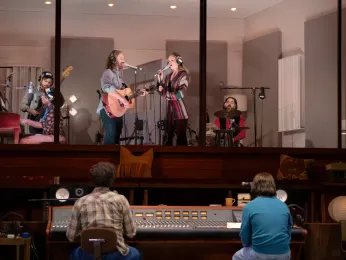
Taking place almost entirely in a state-of-the-art Sausalito recording studio in 1976, the show chronicles the constantly simmering, but only occasionally explosive, quotidian details of a British-American rock group recording the potentially career-galvanizing follow-up to its first hit album. (According to a projected supertitle, the final scene takes place in Los Angeles, but it’s played on the same period-perfect set, designed by David Zinn, used for the entire show).
Theater industry scuttlebutt suggests that the play’s action maps closely to the recording of Fleetwood Mac’s “Rumours” at Marin’s famed Record Plant, which Adjmi has acknowledged as one inspiration. But, while the cast’s line readings, postures, and gaits have a convincingly lived-in non-fiction feel about them, to assume that lead singer Diana (Claire DeJean) is a fact-based Stevie Nicks avatar, control-hungry Peter (Denver Milord) is simply a Lindsey Buckingham stand-in, and so on, is to diminish the rich psychological imagination Adjmi and Aukin have applied to crafting their characters.
Inner conflict made visible
“Stereophonic” is not a play about celebrity. It’s about creative process, a notoriously difficult subject to bring to life on stage or in film. But by portraying a collaborative effort rather than the work of a solo artist, Adjmi is able to raise deep-seated tensions that are often invisible up to the surface where we can see them play out in detail.
Battles of extreme perfectionism versus solid accomplishment, expansiveness versus concision, and dedication to art versus commitment to life’s other pressing necessities are internal conflicts for creators in all media. In focusing on a fictional, unnamed band rather than a canonically enshrined real-life individual (consider the recent film takes on Bob Dylan and Bruce Springsteen), Adjmi is able to make lively dialogue of internal monologue. The group dynamic spares audiences the ponderous verbal mission statements that often plague solo portraits of artists on stage and screen.
And because the band’s record label seems to have granted them endless supplies of time, money, and creative control to make their album, audiences are largely spared clichéd clashes between money-hungry media moguls and earnest artists.
Rather than a sanctimonious look at music biz sausage making, Adjmi provides an MRI of the creative mind. While “Stereophonic” succeeds as a fine-textured group portrait, it can also be enjoyed as a coke-stoked, grown-up twist on the “Inside Out” movies.
Songs and struggles
At three hours’ running time, with periods of fiddling around in the studio lounge and seemingly unproductive musical noodling, “Stereophonic” will no doubt strike some audience members as overlong and loosely strung. The dialogue, replete with awkward silences, is reminiscent of playwright Annie Baker’s lifelike work in her Pulitzer-winning “The Flick.”
To anyone who has ever poured their guts and vision into creating work that really mattered to them, though, the dry stretches and near-longueurs in “Stereophonic” may feel comfortingly familiar: The play pins down the feelings of aimless drift and tangential distraction that are an inherent part of art making, along with the occasional lightning strike of inspiration.
In “Stereophonic,” those thrilling bolts often manifest in the form of guitar-centric rock songs by Will Butler (of the Grammy-winning band Arcade Fire) played live in short takes and fragments by the cast members throughout their onstage recording sessions. The performers’ instrumental and vocal skills are entirely convincing, and the songs’ California-rock harmonies offer hat tips to the Eagles and the Steve Miller Band as well as Fleetwood Mac.
Because the songs are performed with ragged edges and rock show intensity rather than as crisp, clear musical theater numbers, it’s unclear, when first heard in the context of a performance, whether their lyrics shed additional light on the play’s characters or themes. But the overall sonic vibe, like Enver Chakartash’s flared leg, vest-heavy costuming, does plenty of era evoking. (Thespo-cryptologists and Easter egg hunters are welcome to explore full versions of the tunes in a cast album).
Among the uniformly excellent onstage ensemble, Steven Lee Johnson and Jack Barrett make the most of their smaller parts as recording engineers, bringing welcome humor to subtly complex roles. Simultaneously serving as admirers and critics, they’re the structural honeycomb of the creative hive mind.
“Stereophonic,” through November 23. $62-$181. Curran Theatre, 445 Geary Street. www.broadwaysf.com .